Adoption coach
Bina de Boer
You can close your eyes to what you do not want to see. But you cannot close your heart to what you do not want to feel.
Distance and Adoption: The Path from Loss to Reconnecting with Who You Originally Were
Separation and adoption are profound experiences that often occur in the early, pre-verbal phase of life, or during a period when adoptees have not yet mastered the Dutch language. These early events are remembered by the body, even if conscious memories are lacking. Later in life, adoptees may be confronted with emotional reliving of feelings such as anger, sadness, loneliness, and intense homesickness (also known as Hiraeth), without a direct explanation. Because the brain was often not yet fully developed during adoption, these experiences were not stored as explicit memories, but they have left their mark on the body.
These profound experiences are recorded in bodily or cellular memory and cause our brain to develop various survival mechanisms to cope with these traumatic events. Examples include dissociation (splitting thoughts, feelings, memories, or even identity), freezing, excessive adaptation, self-effacement, or constantly trying to please others to gain approval or unconditional love.
An additional consequence of these adaptation mechanisms is that many adoptees lose themselves in an attempt to adapt to the culture of their country of adoption. This leads to a painful inner struggle in which their outward appearance and inner experience do not correspond with their surroundings. Like people with a migration or refugee background, they often feel the pressure to fully assimilate, causing them to partially or completely lose themselves. This can lead to an intense desire to physically fit in with the dominant culture as well, such as a desire for a Dutch appearance.
The In-between Land: At Home in Neither World
Intercountry adoption — literally “between countries” — places adoptees in a unique situation where they often find themselves caught between two worlds, yet never truly feel at home anywhere. On the one hand, they miss the roots, language, and culture of their country of birth, while on the other, they never feel fully part of the country of adoption. They unconsciously experience a inability to meet "the norm." This can trigger a deep sense of loneliness, rootlessness, and isolation. Many adoptees describe the feeling of always standing 'on the sidelines,' without feeling truly connected anywhere. This lack of a clear sense of identity and home base can lead to identity issues and feelings of not being seen or acknowledged.
From Invisible Suffering to Visible Healing
Because the trauma of separation and adoption often lurks beneath the surface, it can take a long time for adoptees to become aware of the impact these experiences have had on their lives. By applying systemic work, body-oriented trauma work, and psychoeducation in both group and individual sessions, adoptees can learn step by step to connect with what has been lost. Healing often begins with acknowledging and recognizing the grief for what has happened to them before they can begin to reconnect with their true selves.
The goal of this journey is not only to process what has happened, but also to rediscover one's own identity, independent of the adoption. It can be a path to breaking through survival mechanisms, such as suppressing one's own needs and constantly seeking external validation. By feeling deeply and allowing the original pain, adoptees can rewrite their own story. As a result, they increasingly connect with their authentic selves, creating space to live from who they truly are, rather than surviving based on old patterns.
Reconnecting with the Hidden Identity
The path to healing is a journey back to who you originally were before the traumatic separation occurred. This involves acknowledging lost cultural, familial, and personal identity. By reconnecting with themselves, their emotions, and the hidden layers of their identity, adoptees can discover what they needed during these profound experiences. This involves not only cognitive understanding, but primarily body awareness and emotional processing. Through this integration, they can make the transition from surviving to truly living—a life in touch with their needs, desires, and authentic selves.
From Loss to Connection: A Path to Wholeness
Ultimately, this path of healing revolves around regaining the connection with oneself: their deepest core, their body, and their emotional world. When adoptees learn to embrace the loss while simultaneously integrating their full identity, a sense of inner peace and fulfillment emerges. They step out of the shadow of not being seen and begin to live from their own strength and authenticity. As a result, they not only find inner peace but are also able to reconnect with their relationships and the world around them in a way that empowers them and reflects their true selves.
On the Way to Yourself: A Step Towards Healing and Reconnection
Do you sometimes feel caught between two worlds, without truly belonging anywhere? Are you dealing with feelings of loss, loneliness, or alienation that you cannot always explain? As an adoptee, it can be difficult to connect with yourself and your past. Together, we can embark on a search for healing and self-insight.
Feel welcome
I invite you for a no-obligation introductory meeting. We will discuss your experiences and how you can take the first steps towards peace, processing, and reconnecting with your true self.
Please feel free to contact me to make an appointment. I look forward to meeting you.
Bina de Boer
Biography
How is Bina?
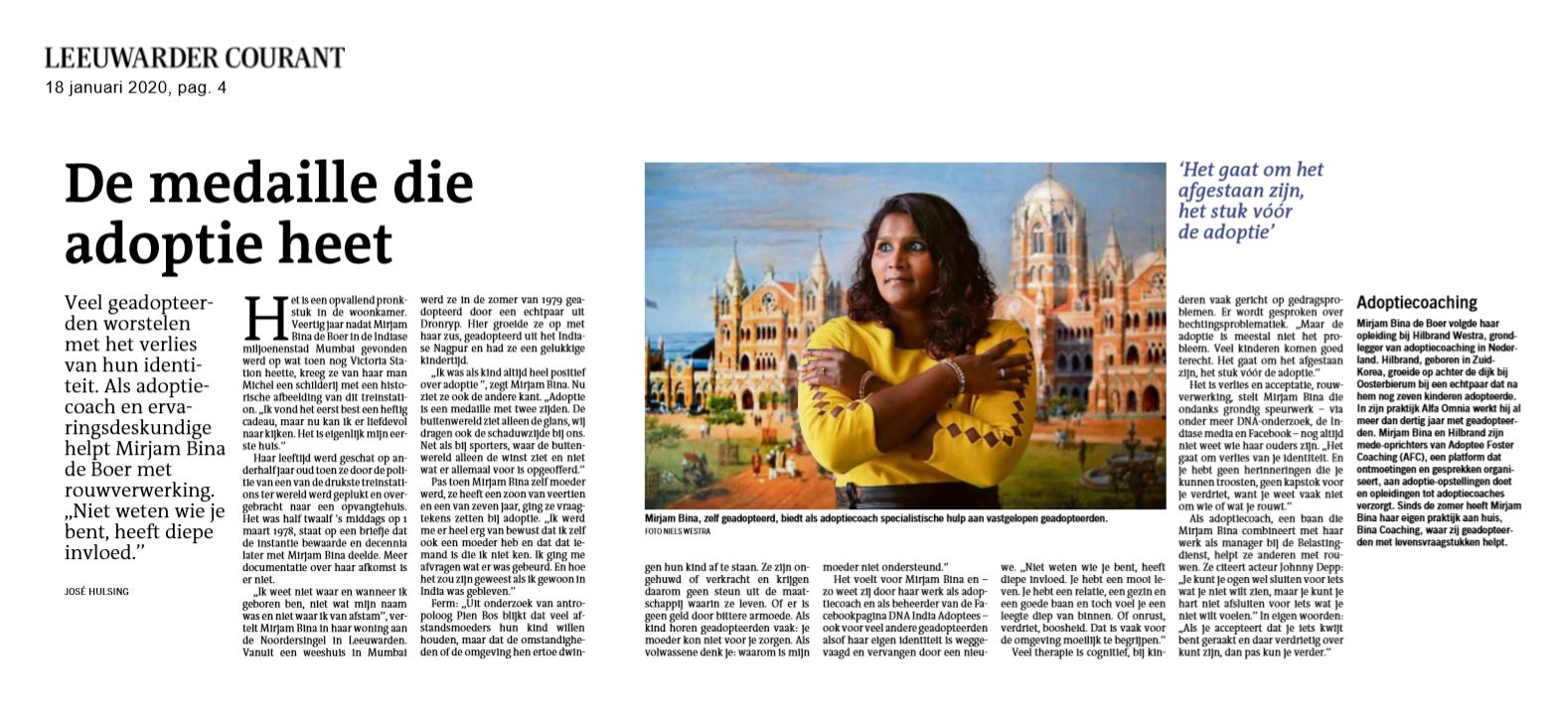
Born in India and raised in Friesland as Mirjam, Bina had a happy childhood until she was fourteen. Her life changed drastically after the sudden death of her (adoptive) father and a move to a new stepfamily. She is now married and a mother of two children. Alongside her former career as a Senior Team Manager at the government and various commercial companies, since June 2019, Bina has focused on supporting adoptees, adults in foster care, donor-conceived children, and people with a background of early childhood trauma or migration as a professional Transcultural Systemic Adoption & Trauma Coach and Trainer.
Why do I do what I do?
After the loss of her (adoptive) father and the birth of her two children, Bina realized that she had different questions than her friends. Due to a lack of adoption-specific support, she decided to embrace her own life mission: to make visible and influence the impact of early childhood trauma on (young) adults. Bina wants to ensure that adoptees, foster children, and people with a migration or early childhood trauma background no longer stand alone. Since 2005, Bina has focused on the emotional and inner development of adoptees.
Bina Coaching
In 2019, she founded Bina Coaching, forty years after her arrival in the Netherlands, to start her practice. Her personal experiences with joy, sorrow, and loneliness were the driving forces to become a coach.
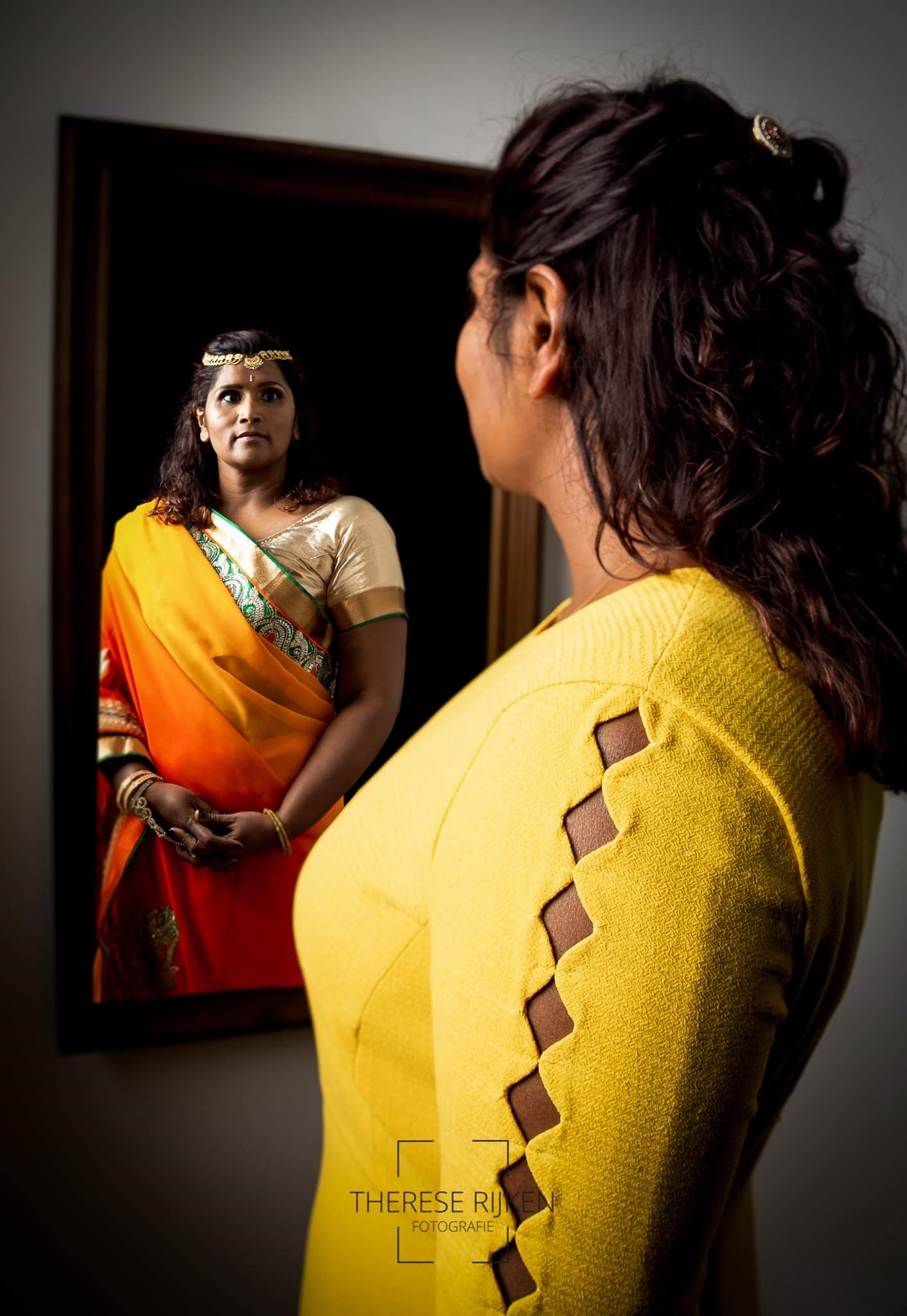
Bina Coaching symbolizes her identity: Bina is the name given to her in India, which means "Without" in Hindi, where she endured many life experiences without empathetic support. As a coach, Bina acts as a mirror to reveal the inner wisdom of others.
As a Transcultural Systemic Trauma Coach and Trainer, she supports adoptees, foster children, and people with migration or early childhood trauma. Her approach integrates psychoeducation with systemic methods and body-oriented trauma work.
Bina's career
Bina has been active in the adoption field since 2005 and has organized activities for adoptees. She started as a volunteer at Wereldkinderen and as an International Representative for ICAV. In 2015, she founded the Facebook Community DNA India Adoptees and serves as a liaison with the Ministry of Security and Justice regarding the Centre of Expertise for International Adoption.
Around 2018, Bina transitioned to become an Adoption Coach and Expert and co-founded AFC, where she worked as a Senior Systemic AFC Coach & Trainer and Training Coordinator. Additionally, she co-developered the Minor "Professional Support in Surrender and Adoption" at HAN University of Applied Sciences Nijmegen. Since November 2022, she has been working as a freelance project manager at INEA, the Centre of Expertise for Intercountry Adoption, where she provides training, peer supervision, and internal and external professional development.
Bina about her adoption
I describe my adoption as a large, shiny golden medal, of which the outside world is often blinded by the gold, but does not see the dark side—distance and loss—and/or the weight (the sacrifices) of the medal.
cannot feel.
Sacrifices such as my name, identity, date of birth, and loss of family and country.
From life story to life mission
I do not remember the trauma of loss, but it is stored in my body. NLP, Systemic work, and Somatic Experiencing have been a godsend for me in my processing. The appalling lack of expert aftercare for adoptees has been the driving force for me to start working as an Adoption Coach.
Activities
Activities Bina CoachingGALLERY